Do surfboard channels actually work? What they change and cost
Updated 2026-09-19
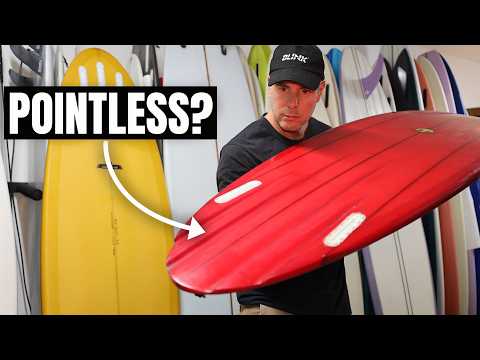
Channels work, but only in certain conditions and on certain boards. They are grooves near the tail that direct water flow and add drive and stability, acting a little like a fin, with an average four-channel setup roughly equivalent to a third of a fin's worth of hold. They suit clean, good-quality waves and straight-line speed. They do less for you in small, sloppy conditions, and on a board built for very small waves, skipping them altogether is often the better call.
Diamond tails and channels: the fastest combination I own
Tail shape matters as much as the channels themselves. A diamond tail is slightly pulled in compared with a swallowtail but keeps more surface area than a pin tail, which adds lift and control. My fastest board measured to date, a twin fin with a diamond tail and channels starting about two feet from the tail, has hit 41.7 km/h (25.9 mph). Removing the centre fin drag of a thruster setup and adding that tail and channel combination together is what gets it there on big, fat waves.
Belly channels: locking in early, fast, harder to pivot
A belly channel starts around the halfway point of the board rather than near the tail, running through the concave and out the back with extra channels added toward the tail. It creates a noticeable sensation of the board locking in as the water finds the channel, then accelerating and spreading out as speed builds. The trade-off is that the board becomes tracky, meaning it resists turning side to side as easily as a flatter, vee-only bottom would in small waves. Once you are locked in, though, it holds a line without slipping.
Four channels near the tail: for smaller, medium-wave fish
On a swallowtail fish suited to smaller and medium waves, four channels starting right where the fins sit, rather than further up the board, add grip without hurting maneuverability. Compared with the same outline in a smooth-bottomed version, the channelled board actually wants smaller fins, because the channels themselves are supplying grip that would otherwise need to come from bigger fins. That means less friction in a straight line and a livelier, more responsive feel, while turning is barely affected because the channels sit so far back.
Single channels: the simplest compromise
A single channel, just one slot rather than a set of four, adds a touch of extra tail rocker and lift. It is common on Campbell Designed boards and pairs well with a medium or half-keel fin without overcomplicating the turn. This is probably the easiest channel type for a shaper to produce, and in my experience it strikes a good balance between the ease of a no-channel board and the extra hold and speed a channel bottom provides.
Subtle arched channels: speed without a hard edge
A more unusual, subtly arced single channel, starting almost halfway down the board and fading out as the tail rocker rolls in, produces very little that you can actually feel underfoot. There is no hard edge or grabby sensation, just extra speed and maneuverability, closer to how a fast single fin surfs than a typical channel board. On a board where the twin fins sit close together and quite upright, this subtle channel setup works without adding any tracky feeling at all.
Aggressive channels: a lock-in step-up shape
On a step-up board with close-together fins and a pointier tail, deep, aggressive channels create a strong sense of locking in and accelerating, similar to a Formula One car finding grip. They start further forward on the board, which limits how large a turn you can throw, but the trade for that is straight-line speed on a board that is already built to hold a line in bigger surf.
When channels are not worth it
A board with genuinely large fins, like a wide swallowtail fish with big glassed-on keels, does not need channels. The fins alone are already capturing all the hold and drive the board can use, so adding channels there is unnecessary. The same goes for boards intended purely for groveling in small, weak surf: channels add cost without adding anything you will feel.
What channels add to the price and the build
Channels typically add somewhere between 50 and 120 dollars to a custom order, and they add complexity to any repair, since a damaged, channelled bottom is harder to fix than a flat one. Fin setup can also be constrained: glassed-on fins are common with channels because they are easier to place accurately, and some configurations force a choice between channels and extra fin boxes. On one of my own boards, adding a fifth fin box for a quad setup meant giving up the channels entirely, because the shaper could not fit both around the boxes.
Questions people ask
Do surfboard channels actually make a board faster?
Yes, particularly from the belly of the board back, on clean, good-quality waves where you want to hold a straight line. They add less in small, sloppy surf.
Do channels make a board harder to turn?
A belly channel that runs from the middle of the board back does trade off some pivot for straight-line speed. A channel confined to the last two feet near the tail barely affects turning at all.
How much do channels add to the cost of a custom surfboard?
In my experience, somewhere between 50 and 120 dollars, depending on how many channels and how complex the pattern is.
Should a small-wave board have channels?
Generally no. A short, wide fish or a dedicated groveler gets little benefit from channels and the extra build cost and repair complexity are not worth it.
Can channels replace a bigger fin?
To a degree. A four-channel setup is roughly equivalent to a third of a fin's worth of hold, which is why a channelled board can often run a smaller fin than the same shape without channels.
Channels and fin choice work together, so see which type of twin fin suits you and how to choose fins for your twin fin surfboard for how the two combine on real boards. For the fin side of the equation in more depth, visit do fins make a difference. The channelled boards mentioned here are part of my current quiver and boards I have sold.