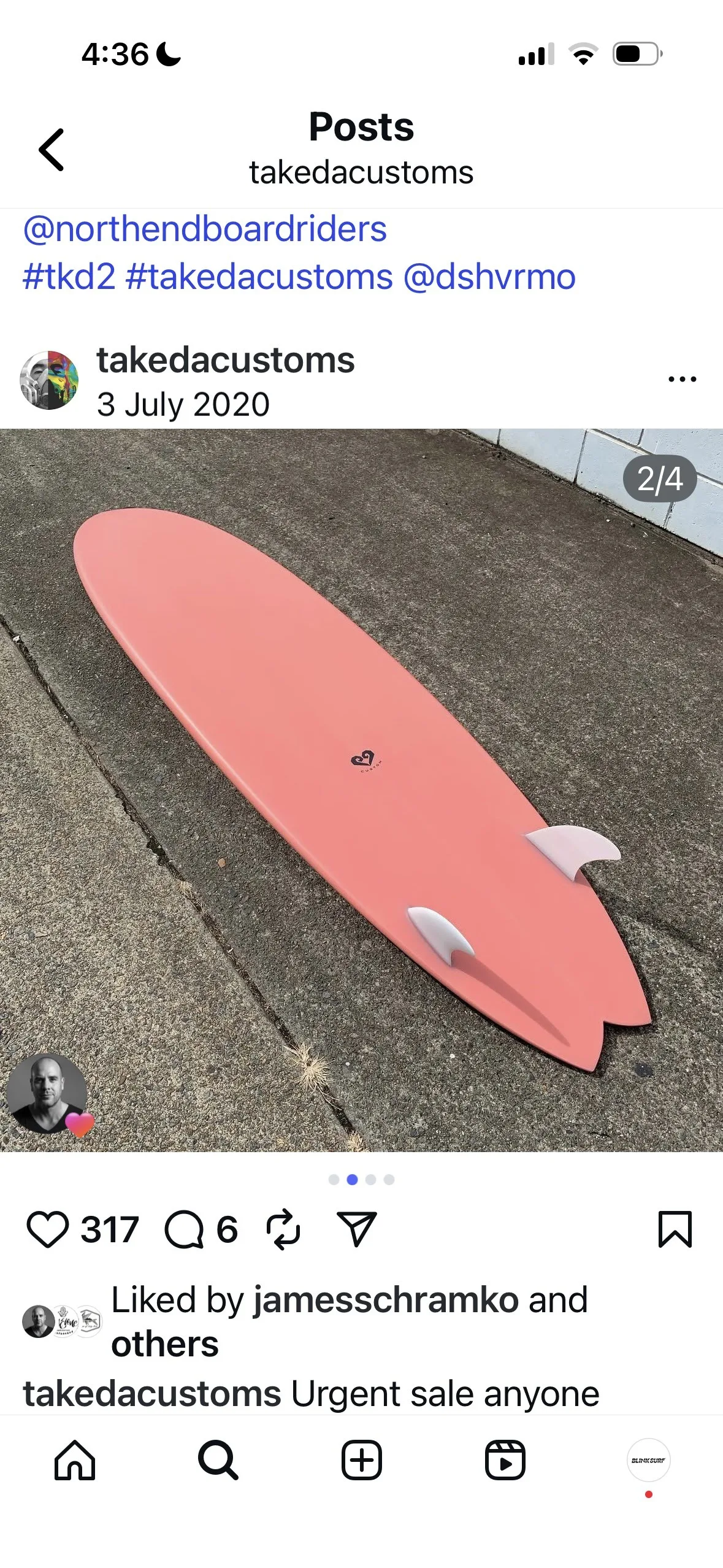
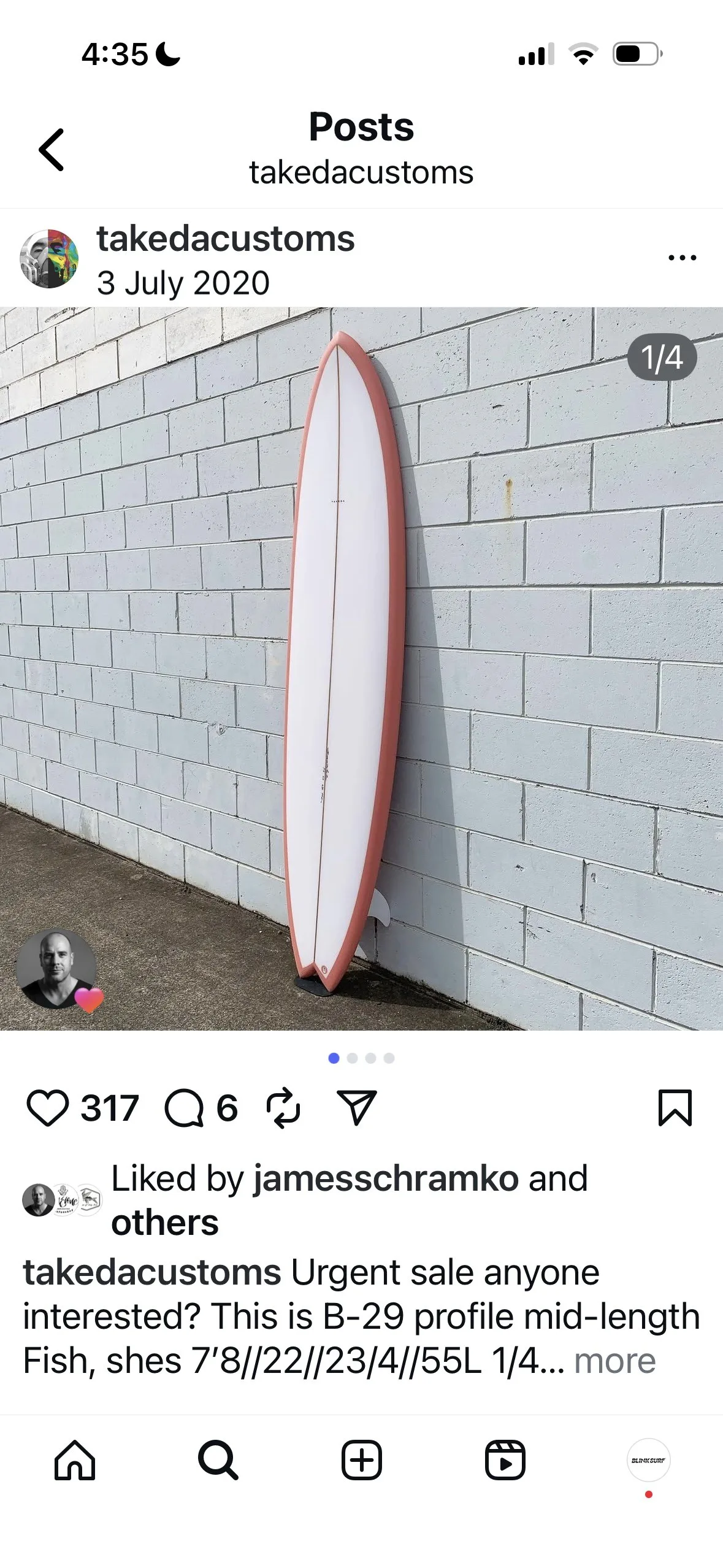
The Twin Fin Mid I Kept Longer Than Any Other, Then Finally Sold
Updated 2026-09-19

| Length | 7'8" |
|---|---|
| Width | 22 in |
| Thickness | 2 3/4 in |
| Volume | 55 L |
| Fin config | Twin |
| Top speed | 33.7 km/h |
| Wave range | 1 to 8 ft |
Most boards in this rack move on quickly. This 7'8 twin fin mid-length, custom shaped on the Gold Coast in a pink and white finish, stayed in rotation longer than any other board owned in the last five years, and it still ended up sold. As at January 2026, here is why it earned that much time in the rack, and why it went anyway.
How it ended up in the rack at all
This board was not ordered for this rider. Another buyer's order fell through, the shaper posted it for sale, and it got picked up as a solution to a specific problem: a crowded home lineup that needed a board able to paddle around people while still catching anything worth catching. At 7'8 x 22 x 2 3/4, 55 liters in PU with a cedar stringer and a sanded finish, it delivered on that from the first sessions.
The shape
A rounded, pulled-in swallow tail sits behind thick, forgiving rails, a medium nose rocker and a slight tail rocker, a shape built for stability rather than edge. The bottom runs a slight belly into a mild single concave before finishing in a double vee out the tail. It came stock with fixed upright fins: fast and responsive, but a little twitchy underfoot.
Opening up the fin boxes
About three years into ownership, a small transport mishap damaged the fixed fins, and rather than replace them like for like, they came out in favor of Futures boxes. That single change turned a fixed-fin cruiser into a board worth testing properly: uprights, half keels, S-Wings and a C-Drive all went through it. S-Wings won clearly, delivering the board's top logged speed of 33.7 km/h on a favorite point wave, with a long, slingshot-style release into gentle, arcing turns. The lesson that came out of that testing run matters beyond this one board: versatility in a twin fin is not just about the outline, it is about the fin configuration and how wide the fins are set.
How it compared to other boards in the rack
Once the fin boxes opened this board up, it paddled better than a 7'10 mid-length from another well-known shaper, and it proved more responsive than a fish of the same length from a different brand again. It covered everything from small summer slop through to clean, head-high waves without needing a second board on standby, which is a rare claim for anything in a quiver built around specific-purpose boards.
Why it still had to go
Three other boards in the rack cover the same wave range this one does: a 7'6 single fin with side bites rated close to a perfect board, a 7'6 channel-bottom twin from another brand described as genuinely desirable, and an 8'1 twin that is smoother again and still turns on a dime. Having several boards doing the same job is where a full quiver starts to work against itself: standing in front of the rack deciding which one to grab, or second-guessing the choice once already in the water, is its own kind of cost. After five years of heavy use, with small deck impressions and a few scars on the underside to show for it, this board's job was done, and it was time to let someone else get the same use out of it.
Questions people ask
Why would a board ridden this much still get sold?
Because three other boards in the same quiver cover the identical wave range. Riding one board this much is a sign it works, not a reason to keep every board that also works in those conditions.
Does swapping fixed fins for a fin box actually change how a board surfs?
On this board, completely. A twitchy, fast fixed-fin setup became a genuinely versatile board once S-Wings, half keels and a C-Drive could all be tested in it.
What fin gave the most speed in this board?
S-Wings, with a top logged speed of 33.7 km/h on a favorite point wave, out of every fin type tried once the boxes went in.
How long is normal before a board gets sold here?
Most boards move on quickly. This one is a clear outlier for how long it stayed, which is part of why it is worth writing about at all.
Can one twin fin mid-length really replace several other boards?
This one came close, paddling better than a longer mid-length and surfing more responsively than an equal-length fish, but it still had direct competition in the rack that covered the same range, which is ultimately why it was sold.
For the boards this one was competing against for wave range, see I sold 25 surfboards, these 4 were the hardest. For the wider argument on keeping a smaller quiver, see how many surfboards do you need and the purge. For fin choice changing a board's whole character, see do fins make a difference. This board's full record now sits on its own board page, alongside the rest of the sold list.